






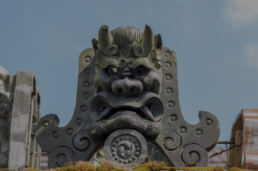
La Leggenda di Shuten-dōji: Il Re degli Oni e la Notte del Sakè Avvelenato
Tra le vette oscure e nebbiose del Monte Ōe, a nord-ovest dell'antica capitale Kyoto, si celava un tempo uno dei pericoli più terrorizzanti del Giappone di epoca Heian: Shuten-dōji (酒呑童子), il "ragazzo che beve sakè". Dietro questo nome dall'aria quasi innoce, si nascondeva in realtà il più feroce e potente Re degli Oni (i demoni del folklore giapponese).
Ecco la storia di come una minaccia brutale che terrorizzava la capitale venne sconfitta non solo con la spada, ma con l'astuzia, l'illusione e il nettare preferito dai demoni.
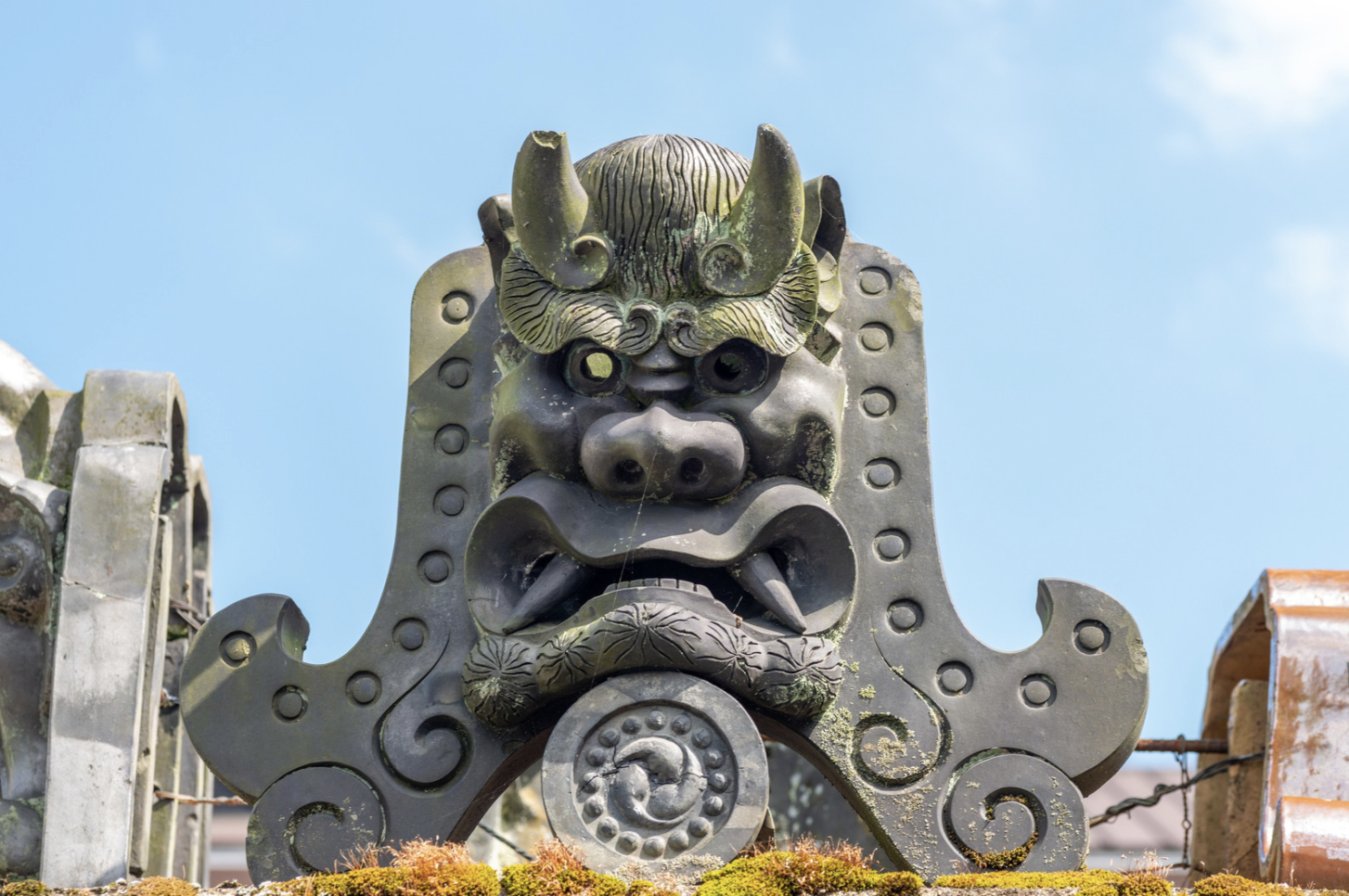
Il terrore di Kyoto e il rapimento delle Dame
Durante il X secolo, la raffinatezza e la pace di Kyoto vennero scosse da una serie di sparizioni misteriose. Giovani donne appartenenti alle famiglie nobili della corte imperiale svanivano nel nulla durante la notte. Presto, divinazioni ed oracoli rivelarono l'orribile verità: Shuten-dōji e la sua orda di demoni scendevano dal Monte Ōe per rapire le ragazze, portandole nel loro fortezza tra le montagne per ridurle in schiavitù e divorarle durante i loro banchetti.
Disperato, l'Imperatore ordinò al più grande guerriero dell'epoca, Minamoto no Yorimitsu (noto anche come Raikō), di porre fine al regno di terrore del demone insieme ai suoi fedeli compagni, i celebri Quattro Re Celesti (Shiten'nō).
L'inganno e il Dono Divino
Attaccare frontalmente una roccaforte di demoni dotati di forza sovrumana sarebbe stato un suicidio. Raikō e i suoi uomini decisero quindi di ricorrere al tranello: si travestirono da yamabushi (monaci asceti di montagna) e nascosero le loro pesanti armature e le spade all'interno dei bauli in legno che portavano sulle spalle.
Lungo la strada verso la cima del Monte Ōe, i guerrieri incontrarono tre anziani misteriosi, in realtà divinità Shintoiste giunte in loro aiuto, che donarono a Raikō un elmo protettivo e un barile di un sakè speciale chiamato Jinben Kidoku-shu. Questo elisir era delizioso e curativo per gli esseri umani, ma agiva come un potente veleno paralizzante e soporifero per gli oni.
Il banchetto e la decapitazione del Demone
Accolti nella fortezza, i monaci camuffati vennero ricevuti da Shuten-dōji in persona. Il Re degli Oni, enormemente amante dell'alcol, accettò con entusiasmo la bevanda offerta dagli ospiti. Durante la festa, mentre i demoni bevevano a fiumi e festeggiavano, il sakè divino fece il suo effetto. Shuten-dōji si accasciò nel sonno, mostrando la sua vera e spaventosa forma: un mostro gigante dalla pelle rossa, con cinque corna e ben quindici occhi.
Raikō e i suoi uomini indossarono rapidamente le armature, sguainarono le spade e attaccarono. Con un colpo netto della sua celebre katana, Raikō tagliò la testa di Shuten-dōji. Ma la ferocia del re demone era tale che, anche una volta staccata dal corpo, la sua testa spicco un balzo in aria per azzannare il guerriero! Solo grazie al magico elmo donatogli dagli dei, Raikō riuscì a proteggersi e a porre fine per sempre all'esistenza del mostro.
Il Simbolismo dietro il Mito
La leggenda di Shuten-dōji non è soltanto un racconto d'avventura e mostri: rappresenta lo scontro storico e culturale tra la civiltà ordinata e raffinata della capitale (Kyoto) e le forze selvagge, ribelli e incontrollabili delle montagne. Ancora oggi, la spada usata da Raikō per decapitare il demone, chiamata Dōjigiri Yasutsuna, è considerata uno dei Tesori Nazionali del Giappone.


Kitsune no Yomeiri: La Leggenda della Pioggia col Sole e i Matrimoni delle Volpi
Vi è mai capitato di camminare all'aperto e ritrovarvi sotto una pioggia leggera mentre il sole splende alto nel cielo? In Occidente lo chiamiamo spesso "matrimonio delle streghe", ma in Giappone questo fenomeno meteorologico nasconde una leggenda profondamente legata al folklore e agli spiriti della foresta: il Kitsune no Yomeiri, letteralmente "Il Matrimonio delle Volpi".
Le volpi (Kitsune) sono tra le creature magiche più importanti della cultura nipponica. Messaggere del dio Inari, sono mutaforma intelligenti, ironiche e dotate di poteri straordinari. E quando decidono di sposarsi, lo fanno nascondendosi dagli occhi degli umani in un modo davvero unico.
Oggi vi portiamo dentro un bosco avvolto dalla nebbia, alla scoperta di un antico segreto.

La Pioggia col Sole come Scudo Magico
Secondo la leggenda, le volpi celebrano i loro matrimoni solo in condizioni atmosferiche molto particolari: quando piove ma c'è il sole (sunshower).
Perché questa scelta? Nel folklore si crede che le volpi usino la pioggia lucente come un vero e proprio incantesimo visivo, uno schermo magico per distorcere la vista degli esseri umani. Le volpi sono creature orgogliose e gelose dei propri rituali; la pioggia serve a fare in modo che nessun uomo possa avvicinarsi o interrompere la sacra cerimonia del loro corteo nuziale.

Il Boscaiolo e le Lanterne nella Foresta
Una delle storie più famose racconta di un vecchio boscaiolo che, sorpreso da questa strana pioggia solare nel cuore del bosco, decise di rifugiarsi sotto le fronde di un enorme albero secolare.
Mentre aspettava che spuntasse l'arcobaleno, la foresta si riempì di una nebbia fitta e improvvisa. Attraverso la foschia, l'uomo vide muoversi una fila ordinata di luci tremolanti: sembravano lanterne di carta (chōchin) che fluttuavano a mezz'aria. Strofinandosi gli occhi, il boscaiolo assistette a una scena incredibile. Non erano uomini a reggere quelle luci, ma una solenne processione di volpi che camminavano erette sulle zampe posteriori. Al centro del corteo, vestita con un magnifico kimono nuziale bianco immacolato (Shiromuku), avanzava una splendida volpe bianca: la sposa.
L'uomo rimase immobile, trattenendo il respiro per non farsi scoprire. Sapeva bene che chiunque venisse colto a spiare un matrimonio di volpi sarebbe stato punito dagli spiriti, subendo terribili dispetti o venendo intrappolato per sempre in un'illusione ottica nella foresta.

Le Luci di Volpe (Kitsunebi) oggi
Ancora oggi, in Giappone, le misteriose luci che a volte si avvistano di notte nelle foreste di montagna o lungo le risaie vengono chiamate Kitsunebi (fuochi di volpe) o lanterne nuziali.
Se vi capita di viaggiare nelle aree rurali del Giappone in una giornata di pioggia col sole, guardate verso le montagne boscose: i locali vi diranno, con un sorriso, che da qualche parte tra gli alberi una giovane volpe sta andando incontro al suo sposo.

The Secret of Mount Fuji and the Moon Princess: The Alternative Ending You Didn't Know
Almost everyone is familiar with the story of Kaguya-hime, the breathtakingly beautiful Moon Princess found as a baby inside a glowing stalk of bamboo. It is one of Japan's oldest and most cherished fairy tales, immortalized by Studio Ghibli's cinematic masterpiece.
However, there is a crucial detail—a deeply melancholic alternative ending—that directly links this ancient myth to the creation of the Land of the Rising Sun's ultimate symbol: Mount Fuji.
Today, we unveil the secret mythological history of the world's most famous volcano.

The Return to the Moon and the Farewell Gift
After living on Earth surrounded by the love of her foster parents and rejecting the marriage proposals of the country's most powerful suitors, the time came for Kaguya-hime to depart. Her true family, the people of the Moon, came down to Earth to take her back home.
Among those who wept and fought desperately to keep her on Earth was the Emperor of Japan, who had fallen deeply in love with her. Before stepping into the celestial chariot and losing her earthly memories forever, Kaguya-hime left him a final token of her affection: a heartfelt letter and a small vial containing the Elixir of Eternal Life (Fushi no Kusuri).

The Emperor's Grief
When the Emperor received the vial, his heart shattered. What was the purpose of living forever if he could never again see or hold the woman he loved? Without Kaguya, immortality felt like the most painful curse.
Refusing the divine gift, the Emperor penned a response poem (which the princess would never read) and summoned his most trusted commander. He ordered him to take the farewell letter, the elixir of immortality, and carry them to the peak of the highest mountain in Japan—the place closest to the heavens and the Moon.
There, on the summit, the soldiers were commanded to light a great fire and burn the vial, allowing the smoke to carry the message and the elixir directly back to the lunar kingdom.

How the Legend Created Mount Fuji
The commander followed his orders perfectly. He carried the elixir to the top of the sacred peak and set it ablaze. From that day forward, according to folklore, that volcano became known as Fuji.
While the word Fuji is written today with characters meaning "Wealth of Warriors" (honoring the Emperor's soldiers), its original pronunciation is deeply tied to the word Fushi, which literally translates to "Immortal" / "Eternal Life".
The legend says that the elixir never stopped burning deep inside the mountain. For centuries, the white smoke that historically billowed from the volcano's crater (as Mount Fuji is an active volcano) was believed to be the vapor of the eternal elixir, constantly rising into the sky as the Emperor's everlasting message of love to his moon princess.
Travel Tip
When your clients stand before the perfect silhouette of Mount Fuji, perhaps from the shores of Lake Kawaguchiko or Hakone, sharing this story will turn that view into something truly magical. They won't just be looking at a mountain, but at the very place where the fire of an immortal love has been burning for over a thousand years.

The Legend of Lake Tazawa: The Princess Who Became a Dragon
If there is one thing Japanese folklore teaches us, it is that nature is alive, vibrant, and the keeper of ancient secrets. In Akita Prefecture, nestled among spectacular mountains, lies Lake Tazawa (Tazawako). It is Japan's deepest lake, famous for its almost hypnotic cobalt-blue waters and a golden statue gleaming on its surface, tied to a tale of love, beauty, and metamorphosis: the legend of Tatsuko Hime.
Take a moment to unwind, as today we take you on a journey to discover a timeless myth.

The Desire for Eternal Youth
Many centuries ago, in a small village near the lake, lived a girl named Tatsuko. Her beauty was legendary, so flawless that anyone who looked at her was left breathless. However, with beauty came a deep melancholy: Tatsuko was terrified of the passage of time. She could not accept the idea of her youth fading and her radiance withering away.
Desperate to remain beautiful forever, Tatsuko began traveling every night to the shrine on Mount Okura, praying fervently to the deity Kannon. She prayed for one hundred consecutive nights until the deity, moved by pity (or perhaps to teach her a lesson), answered her: "If you wish to preserve your beauty, go north past the mountain and drink from the magical spring you find there."

The Metamorphosis
Tatsuko rushed northward and found the crystal-clear spring hidden among the rocks. Thirsty, she began to drink. But the more she drank, the more her thirst grew. Overcome by an uncontrollable craving, she kept drinking until suddenly the sky turned pitch black, lightning struck, and the earth shook.
Looking at her reflection in the water, Tatsuko let out a scream of terror: her graceful body was now covered in shimmering scales, her hands had turned into claws, and her face had elongated. She had transformed into a giant water dragon.
Realizing her fate and filled with shame, Tatsuko cast herself into the depths of Lake Tazawa, becoming its eternal guardian and protective deity.

A Love That Never Freezes
The legend, however, does not end there. It is said that on the nearby Oga Peninsula lived another young man turned dragon, named Hachiro-taro. The two fell deeply in love, and every year during autumn and winter, Hachiro-taro would travel to Lake Tazawa to reunite with his beloved Tatsuko.
According to locals, it is the sheer strength of their warmth and profound love that ensures Lake Tazawa never freezes, even during the harsh and snowy winters of northern Japan.
Travel Tip
Today, a stunning golden bronze statue sculpted by Yasutake Funakoshi stands on the lake's shore, depicting Tatsuko before her transformation. Visiting this place means journeying into the deepest stillness of rural Japan.
Fun fact for travelers: If you visit the lake in autumn, the striking contrast between the deep blue water, the gold of the statue, and the fiery red autumn leaves (momiji) will give you an unforgettable photo, straight out of an ancient fairy tale.

Shikigami: Spiritual Guardians and Powerful Entities of Japanese Folklore
Shikigami, fascinating figures in Japanese mythology, are often described as servant spirits summoned by powerful exorcists, known as Onmyoji. Deeply rooted in the tradition of Onmyōdō (an esoteric practice that blends astrology, magic, and shamanism), Shikigami represent one of the most evocative expressions of the interconnectedness between the human and spiritual worlds.

Origin and Meaning
The word "Shikigami" literally translates as "ceremonial spirits" (Shiki, "ceremony" or "command," and kami, "spirit" or "god"). These entities manifest the control and spiritual mastery of the Onmyoji, summoners who draw on cosmic energy to call them and bind them to their service. According to tradition, Shikigami do not have a stable physical form: they can appear as animals, shadows, or even take the form of inanimate objects. In other interpretations, they manifest as small spirit-like creatures or animated paper talismans, a popular image made famous by contemporary culture.
The Functions of Shikigami
Shikigami are not simple assistants; they embody the power and will of their master. They can perform multiple roles, including:
Protection: They act as guardians against evil spirits and negative influences.
Espionage: Invisible or camouflaged, they gather information on behalf of their master.
Attack and Defense: They are spiritual weapons, capable of fighting enemy entities or neutralising curses.
Rituals: Onmyoji use them as conduits to channel divine energy during ceremonies.

Shikigami in History and Culture
The origin of Shikigami is closely linked to the historical figure of Abe no Seimei, the legendary Onmyoji who was said to be able to summon and control these spirits with unparalleled ease. Throughout the centuries, Shikigami have found their way into historical chronicles, folklore, and art and literature. In modern times, the fascination with Shikigami has been amplified thanks to their presence in anime, manga, and video games, where they are often depicted as loyal companions or powerful allies.
Shikigami Trivia
The concept of Shikigami may derive from ancient Chinese Taoism, which attributed to shamans the ability to summon servant spirits.
Traditionally, Shikigami do not have an autonomous personality, but their strength depends on the power and spiritual purity of the Onmyoji. Furthermore, Shikigami are not intrinsically good. If summoned without proper preparation, they can rebel, causing enormous damage to their master.
Symbolism and Timeless Appeal
Shikigami represent the link between the invisible and the tangible, a symbol of the human ability to interact with otherworldly forces. Although their power is shrouded in mystery, they also reflect the values of discipline and responsibility: summoning a Shikigami is an act that requires dedication and wisdom. This dualism, between a trusted ally and an indomitable spirit, makes Shikigami a powerful metaphor for exploring the boundaries between control and freedom, power and responsibility. Ancient charm and modernity intertwine, transforming these spirits into a bridge between different eras, where mystery continues to capture our imagination.

Yōkai: A bridge between the visible and invisible worlds
Yōkai, fascinating figures of Japanese tradition, represent a theme of great cultural relevance, exerting a profound and often unexpected influence on daily life and the collective imagination
Yōkai are often represented as frightening beings, but sometimes also funny or even benevolent. The term “Yōkai” (妖怪) can be translated as “monster”, “spirit” or “demon”, and their variety is enormous: from ghosts to monsters, from the forces of nature to magical entities. Japanese culture has always seen them as beings that can influence daily life, bringing curses and blessings or simply manifesting themselves to test humanity. One peculiarity that represents them the most is precisely this duality and contrast, which we often find in Japanese tradition and why not, even looking around in the Land of the Rising Sun.

Photo: https://upload.wikimedia.org/wikipedia/commons/d/d5/Suushi_Yuki-onna.jpg
Some of the most famous Yōkai include Oni, a demon often depicted with horns and red or blue skin; Kappa, a water creature with a head containing water, whose strength depends on keeping that water source intact; Yuki Onna, or "Snow Woman," depicted as a beautiful woman with long black hair and snow-pale skin; Kitsune, a legendary fox capable of transforming into a woman and often associated with Inari, the deity of fertility, laughter, and prosperity. There are also less threatening Yōkai, such as the Tanuki, a raccoon dog that, through its transformations, can be both mischievous and playful.

Photo: https://upload.wikimedia.org/wikipedia/commons/b/b1/SekienNureonna.jpg
Japanese tradition attributes a didactic function to these spirits/demons: their stories often served to teach moral lessons or to explain unknown natural phenomena. Furthermore, over the centuries, Yōkai have taken on new forms, adapting to contemporary popular culture, and becoming protagonists of manga, anime and video games. Today, these creatures continue to embody the link between past and present, offering a unique look at the richness of Japanese mythology and its impact on modern society. Their presence in the collective imagination not only keeps a thousand-year-old tradition alive but also guarantees its constant evolution and reinterpretation.


Everything there is to know about Maneki Neko
Surely you have seen Maneki Neko, whether or not you are a fan of Japanese tradition. Shall we give this wonderful and lucky Japanese kitten special attention? Let's take a closer look at them.
Maneki Neko, the beckoning cat from Japan
Author: SaiKaiAngel
Also known as "lucky cat" is famous all over the world. The Maneki-Neko is a true Japanese symbol, with origins in Tokyo during the Edo period.
Originally Maneki Neko were made of wood, metal, porcelain or cast iron. Today they can be found in all kinds of materials, especially plastic.
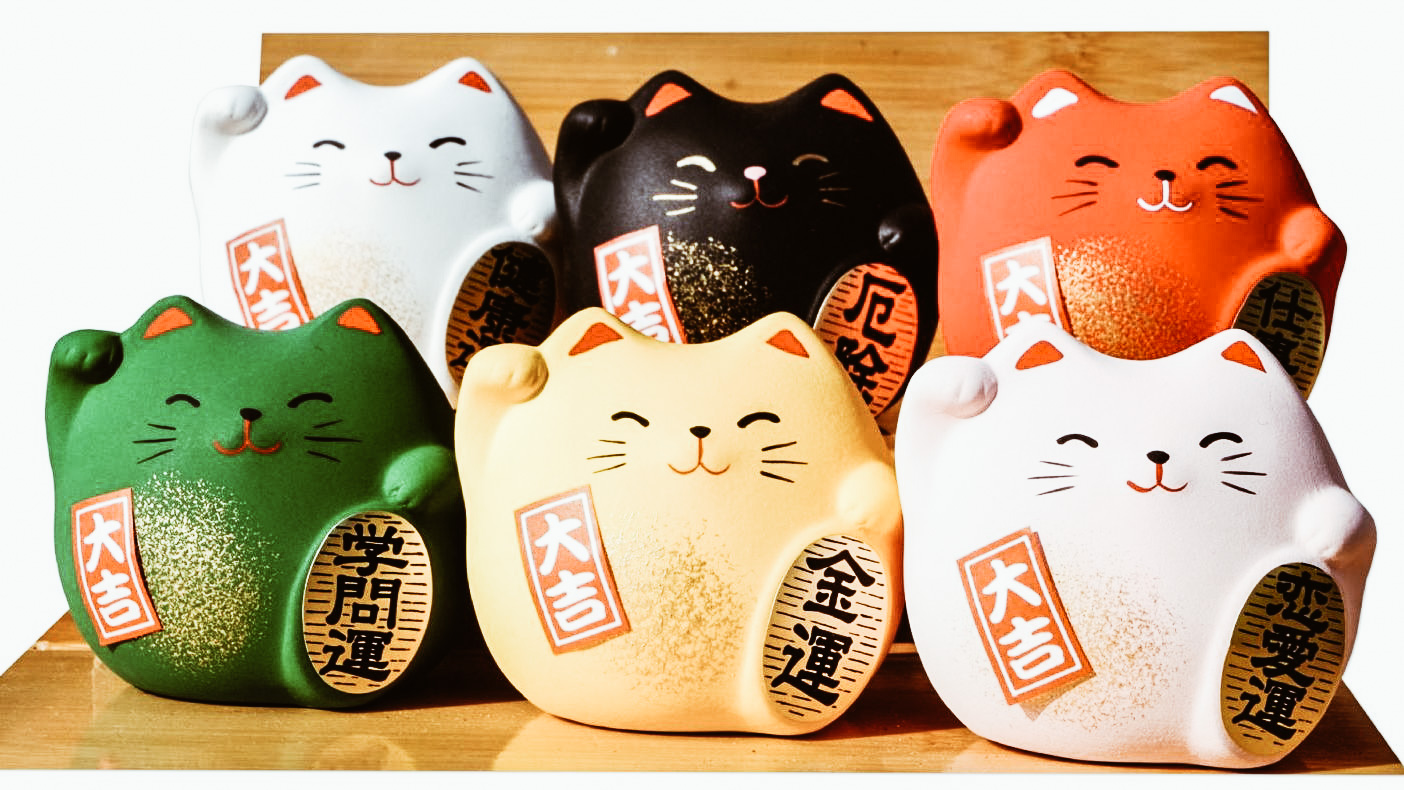
photo credits: www.dailyartmagazine.com
The origins
The origins are shrouded in mystery. There are some tales and the most famous is that of the samurai who, sitting in the rain under a large tree in front of a temple, was called with a nod of his paw. The samurai then headed towards him and at that very moment, a flash of light struck the tree under which he had been a few moments earlier. The cat then saved the samurai from certain death.
Another story tells of a shopkeeper who caught a cat in the rain, and the cat sat down in front of the shop, beckoning the customers to come in, as a sign of thanks.
Another legend, perhaps a little more bizarre, revolves around a courtesan who loved her domestic cat. The owner convinced that the cat was possessed, cut off his head in an attempt to exorcise it, just as a snake was about to bite the courtesan. The decapitated head flew in the air and landed on the snake, killing it instantly and saving the girl. The girl felt desperate because of the loss and, to give her a smile someone made her a statue of her cat, it seems that so was born the first Maneki-Neko.
The differences between Maneki Neko
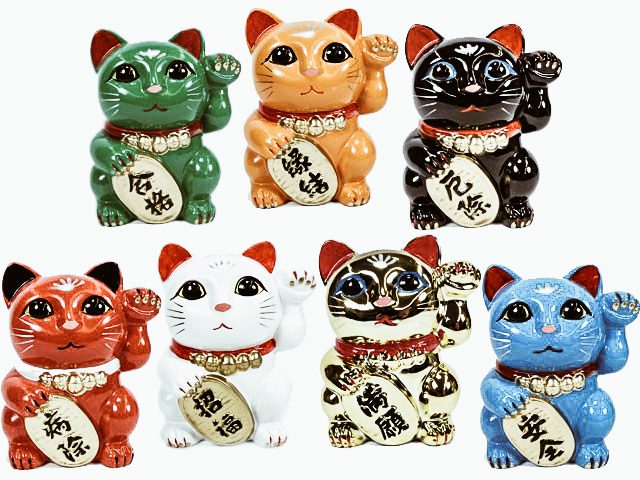
photo credits: @punamkhokhar
The cats all look similar, but if you look closely, you will discover even very small variations that change their meaning.
For example, depending on the position of the paw, Maneki Neko has different meanings:
- Left leg raised: attracts customers and good business. So Maneki Neko with the left paw raised is suitable for businesses, shops and activities that take place mainly at night such as nightclubs, bars and discos.
- Right leg raised: wish money and good luck.
- Both legs raised: it can mean "double luck!" and protection from bad luck, although the gesture can also be seen as a celebratory cheer. Obviously the legs must be at a different height because at the same height they would mean "surrendered" and obviously this is not the case of our Maneki Neko.
We can also occasionally find a coin together with the cat and this, of course, represents prosperity, wealth and money.
The bib and bell are generally associated with protection and abundance.
Who to give the Maneki Neko to?
Obviously, depending on the person we want to pay tribute to, it will be positioned differently. How to find the right place? Read here:
- At home: it should be located in the southeast part of the house, which is the wealth/money area.
- For work: Maneki Neko is usually kept close to the entrances so that people who enter can actually see it. If this is not possible, it can be kept in the northeast area of the business premises.
- For offices: place your Maneki Neko as close to the office as possible.
Of course, even depending on the colour, it has a different meaning, let's go see them all:
- Tricolour: attracts good luck, wealth, prosperity.
- White: the color of purity, white Maneki Neko attract purity and happiness.
- Black: they are seen as guards. They protect against negative energies and evil. They also help drive out stalkers and provide security, comfort and peace.
- Golden colour is associated with wealth and money. This Maneki Neko attracts material and monetary benefits and therefore can be found a lot in shops, restaurants and other workplaces.
- Red: red, like black, is a protector and is used to protect against evil and disease. It is good to keep one in the children's room.
- Pink: pink is the colour of love, so this Maneki Neko attracts love and romance.
- Green: this Maneki Neko helps students to increase their concentration towards their studies, protecting them from diseases and helping them to heal if they need it.
- Blue: attracts peace, harmony and happiness for family members.

Three ways to say "I Love you"
"Ti Amo, I love you" How do you say that in Japanese? There are so many kinds of love, why should we express love only one way? The Japanese know a lot, they know that every kind of love needs a way to be expressed, a completely personal way.
Ti Amo / I Love you, here's how to say it in Japanese
Author: SaiKaiAngel | Source: SoraNews24
All this, you think, happens in a country that is seen as "cold and distant". Perhaps, thinking about this, we should understand that cold and distant is not, indeed. It is a country that gives the right importance to history, tradition and feelings.
Let's start looking at all the ways of showing love in Japanese, let's analyze them one by one.
1. Suki - I like you

This is the most used and most famous way because it is found in many conversations of Japanese animation. We analyze it first also because it is the least "deep", in fact, more than love, it can also mean "I like". You can safely say "Ramen ga suki desu" that no one will see you as a fool in love with a plate of ramen, but everyone will understand that you like ramen. So you can use suki to express an appreciation for a singer or an actor too.
That's why suki can be confusing. If you hear this word, you might run into the question of whether you really like us as a person or just as a ramen dish. It's a very flexible meaning, not at all secure, yet it is used at the beginning of every love story. When you want to propose to someone, you can use suki desu to do so. Very important at that point, it will be the WAY in which you do it, you have to make the other person understand that you have serious intentions and you are not just a dish of ramen. It takes conviction in the voice, it's not a simple "I like". With a great conviction, then you will have the right colour of falling in love.
2. Koi - I love you

We're not talking about the carp, but the second way the Japanese use to talk about love. We're in the field of romantic love here. Koi is the young and passionate emotion, but it's rarely used to say "I love you". Maybe we can bring it closer to "I love you" by Americans, which can mean both "love you" and "deeply care about you". However, the verb koi suru is closer to "to be in love" or "to be romantically involved". In fact, the word Koi is used for Koibito meaning lover.
3. Ai - Ti Amo

And here we come to the most famous, the most used term for the word Love.
Ai is a noun that means "love", but it can be used for something more than just romantic affection. Ai or the variant aijo, are also used to talk about the concepts of love for the family, for a platonic love or for all humanity. Used as a verb, it becomes ai suru.
Then why do we use suki desu to confess our love? Simply because ai is a much more serious and committed feeling. Ai suru would be a bit... frightening, especially for a story that's just begun. We have to go step by step and Suki desu is what allows us to do that. It would also be better to change the verb suru to shiteiru. By telling your partner to the shiteiru, you're showing an ongoing love, not just an initial crush. As far as I'm concerned, it's the term I like best, also because it's the first one I've ever heard.

What does that tell us? That Japanese is a very romantic language despite what you hear. Are Japanese cold? All impression. Japanese can give the right meaning and depth to anything, even love. What term would you use for your love?